Calories in One Bowl of Dal: How Many Calories Does Dal Have?
If you’re watching your calorie intake, trying to lose weight, or simply planning balanced Indian meals, you may wonder about the calories in one bowl of dal.
A typical bowl of cooked dal can contain approximately 150–250 calories, depending on the variety of lentil, portion size, and preparation method. Dal is also a useful source of plant-based protein, carbohydrates, fibre, vitamins and minerals.
However, there’s an important catch: the dal itself isn’t necessarily the biggest contributor to calories. Oil, ghee, butter, cream and other ingredients used for tadka can substantially increase the calorie content.
So, if you’re counting calories, it’s useful to look at both the dal and how it is prepared.
How Many Calories Are in One Bowl of Dal?
For a typical serving of approximately 150–200 g of cooked dal, a reasonable estimate is:
Type of Dal |
Approx. Calories per Bowl* |
|---|---|
Moong dal
|
150–190 kcal
|
Masoor dal
|
160–200 kcal
|
Toor dal
|
180–220 kcal
|
Chana dal
|
190–240 kcal
|
Urad dal
|
190–250 kcal
|
Mixed dal
|
170–230 kcal
|
*Approximate values for a moderate serving. Actual calories vary according to recipe, consistency and added oil/ghee.
A simple dal prepared mostly with lentils, water, spices and vegetables will generally contain fewer calories than restaurant-style dal prepared with generous amounts of ghee or oil.
What Determines the Calories in Dal?
The calorie content isn’t determined by the lentils alone.
Several factors can change the final number.
1. Type of Lentil
Different pulses have different nutritional profiles.
For example:
- Moong dal tends to be relatively light.
- Masoor dal provides protein and fibre.
- Toor dal is commonly used in Indian home cooking.
- Chana dal tends to be more energy-dense.
- Urad dal is also relatively calorie-dense.
The difference isn’t necessarily enormous when comparing similar cooked portions, but it can become meaningful when you’re tracking your overall diet.
2. Portion Size
This is one of the most important factors.
A small katori and a large soup bowl aren’t equivalent servings.
For example:
Small serving: approximately 100–120 g
Medium serving: approximately 150–200 g
Large serving: approximately 250–300 g
If you double the amount of dal, you’re also roughly doubling the calories from the dal itself.
That’s why saying “one bowl of dal contains exactly X calories” can be misleading.
3. Oil and Ghee
This can make a surprisingly large difference.
Dal itself can be relatively moderate in calories, but tadka can add additional energy.
Common additions include:
- Ghee
- Vegetable oil
- Butter
- Coconut
- Cream
If you’re trying to reduce calories, controlling the quantity of added fat can be more effective than eliminating dal from your diet.
Calories in One Bowl of Dal With Tadka
Indian dal is often finished with a tadka, or tempering, made using ingredients such as oil or ghee, cumin, mustard seeds, garlic, onion, chilli and other spices.
The spices themselves generally contribute relatively few calories.
The cooking fat is different.
Even a small quantity of oil or ghee adds calories because dietary fats are energy-dense.
For this reason:
A simple home-cooked bowl of dal and a restaurant-style bowl of dal may have very different calorie counts even if they contain the same amount of lentils.
When tracking calories, pay attention to the preparation method rather than focusing only on the name of the dish.
Is Dal Good for Weight Loss?
For many people, dal can fit very well into a weight-management diet.
That’s because it provides a combination of:
- Protein
- Dietary fibre
- Complex carbohydrates
- Micronutrients
- Plant-based nutrition
Protein and fibre can contribute to satiety, which may make it easier to maintain an appropriate calorie intake.
However, dal isn’t automatically a weight-loss food.
Your overall calorie intake still matters.
A large bowl of dal cooked with substantial amounts of ghee, combined with several rotis, rice and other calorie-dense foods, can contribute significantly more calories than a moderate serving of lightly prepared dal.
Protein in One Bowl of Dal
One of the reasons dal is such an important part of Indian diets is its protein content.
Depending on the variety and serving size, a bowl of cooked dal may provide approximately 7–12 g of protein, although the exact amount varies considerably.
Dal can therefore contribute to daily protein intake, particularly when combined with other protein-rich foods.
For people following vegetarian diets, combining different sources of protein across the day can help create a nutritionally balanced eating pattern.
Fibre in Dal
Dal is also a good source of dietary fibre.
Fibre is important for:
- Digestive health
- Satiety
- Healthy bowel function
- Overall dietary quality
The amount of fibre varies by pulse and preparation method.
Whole pulses generally retain more of their natural structure than highly processed foods.
Calories in Different Types of Dal
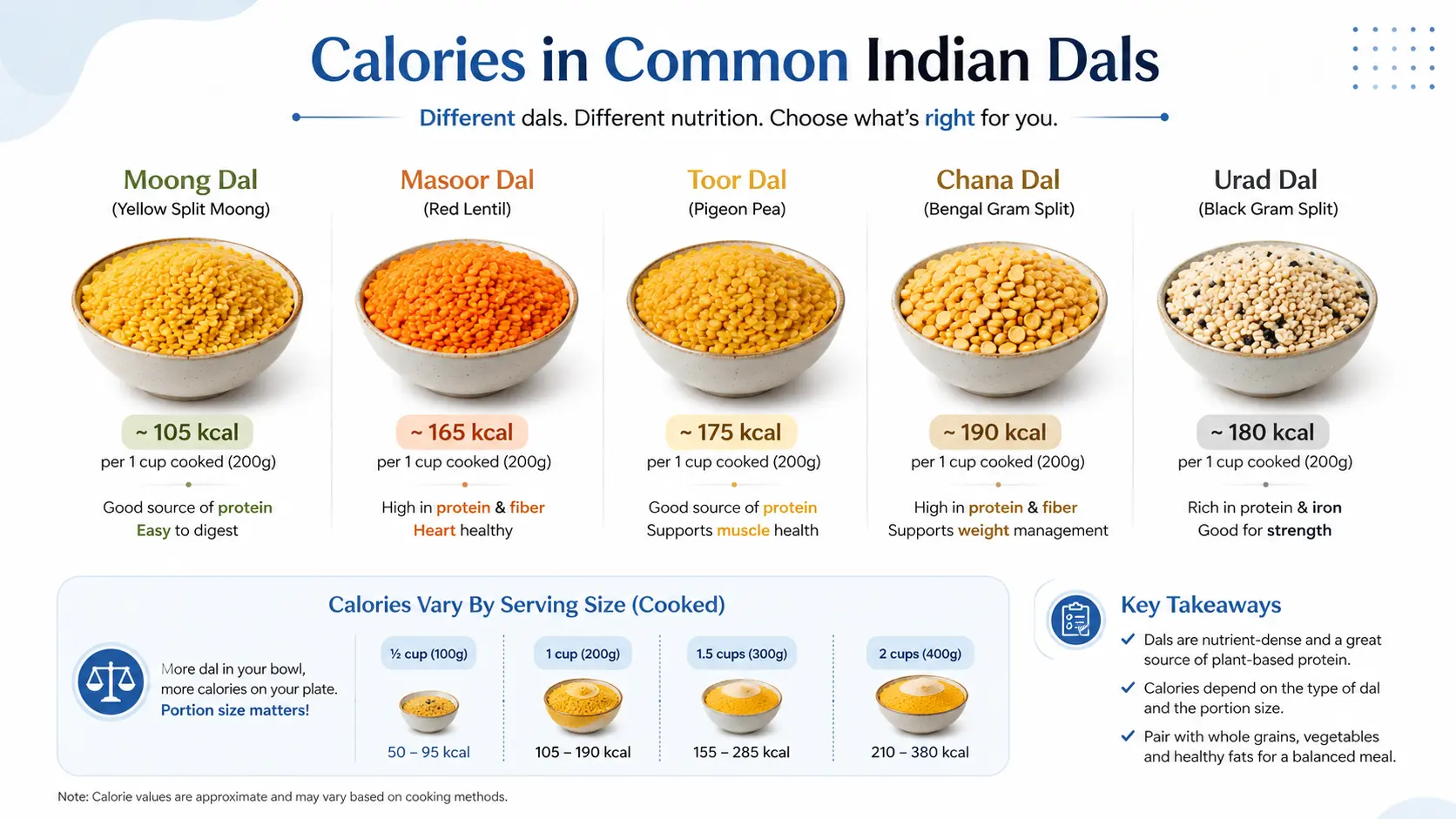
Moong Dal
Moong dal is widely used in Indian households and is often considered a relatively light option.
A medium bowl of cooked moong dal may provide approximately 150–190 calories, depending on the recipe.
It’s commonly prepared as:
- Moong dal fry
- Moong dal khichdi
- Yellow moong dal
- Moong dal soup
The final calorie count increases when additional ghee or oil is used.
Masoor Dal
Masoor dal is another popular pulse and provides protein, carbohydrates and fibre.
A medium bowl may contain approximately 160–200 calories, depending on preparation.
It can be used in soups, curries and everyday dal preparations.
Toor Dal
Toor dal, also called pigeon pea, is a staple ingredient in many Indian households.
It is commonly used for:
- Dal tadka
- Dal fry
- Sambar
- Gujarati dal
- Maharashtrian-style dal preparations
A medium bowl may provide approximately 180–220 calories, depending on ingredients.
Chana Dal
Chana dal is made from split chickpeas and is generally more substantial than some lighter dals.
A bowl can provide approximately 190–240 calories, depending on portion size and preparation.
Because it is relatively filling, it can work well as part of a balanced meal.
Urad Dal
Urad dal is used in many traditional Indian preparations, including dal makhani.
The calorie content can vary dramatically depending on the recipe.
Plain cooked urad dal may be moderate in calories, while dal makhani can be substantially higher because of ingredients such as butter, cream and ghee.
Dal vs Other Common Indian Foods
Looking at individual foods in isolation can be misleading. What matters is the entire meal.
Food |
Primary Nutritional Contribution |
|---|---|
Dal
|
Protein + carbohydrates + fibre
|
Rice
|
Primarily carbohydrates
|
Roti
|
Carbohydrates + some protein/fibre
|
Paneer
|
Protein + fat
|
Curd
|
Protein + carbohydrates
|
Vegetables
|
Fibre + micronutrients
|
This is why dal can be a useful component of a balanced Indian meal.
For example:
Dal + vegetable sabzi + salad + moderate rice/roti
can create a more balanced meal than relying heavily on one food group.
Dal and Diabetes
People with diabetes often ask whether dal is suitable for their diet.
Dal contains carbohydrates, so portion size still matters. However, pulses also provide protein and fibre, which can make them a useful part of a balanced eating pattern.
The appropriate amount depends on:
- Overall carbohydrate intake
- Medication
- Blood glucose response
- Meal composition
- Individual nutritional needs
Rather than completely avoiding dal, people with diabetes should consider how it fits into their overall meal plan.
For personalized diabetes nutrition advice, a registered dietitian or healthcare professional can help determine appropriate portions.
Is Dal High in Calories?
Generally, plain cooked dal is not exceptionally high in calories.
The bigger issue is often what gets added to it.
Compare:
Simple dal
- Lentils
- Water
- Tomato
- Onion
- Spices
- Small amount of oil
versus:
Restaurant-style dal
- Lentils
- Large amount of ghee/butter
- Cream
- Additional oil
- Rich tempering
Both are called “dal,” but their calorie content can be substantially different.
How to Make Lower-Calorie Dal
If you’re trying to manage your calorie intake, you don’t need to stop eating dal.
Instead, consider these approaches:
Use less oil or ghee
Measure cooking oil rather than pouring it directly into the pan.
Add vegetables
Tomatoes, spinach, bottle gourd, carrots and other vegetables can increase volume and nutritional variety.
Control portion size
A moderate bowl can fit more easily into a calorie-controlled meal than an oversized serving.
Avoid unnecessary cream
Cream and butter can significantly increase the calorie content of some dal recipes.
Pair it intelligently
Instead of combining a large serving of dal with large portions of both rice and roti, balance the meal around your individual energy needs.
A Practical Indian Meal Example
Consider a simple lunch:
- 1 medium bowl dal
- 1–2 rotis
- Mixed vegetable sabzi
- Salad
- Plain curd
This provides a combination of:
Protein + carbohydrates + fibre + vegetables + dairy
The exact calorie count depends on portion sizes and cooking methods.
For someone trying to lose weight, the goal isn’t necessarily to remove dal. It’s to create a meal where the total energy intake is appropriate for their individual requirements.
Dal and Weight Management: What Matters Most?
If your goal is weight loss, focus on the bigger picture.
Don’t focus only on:
“How many calories are in dal?”
Also consider:
- How much dal are you eating?
- How much oil is used?
- What are you eating with it?
- How much rice or roti are you consuming?
- What’s your total daily calorie intake?
- Are you getting enough protein?
- Are you physically active?
A nutritious food can still contribute to excess calorie intake if portions are consistently too large.
How to Estimate Your Bowl of Dal
If you don’t have a food scale, you can still make a reasonable estimate.
Step 1: Identify the dal
Determine whether you’re eating moong, masoor, toor, chana, urad or another variety.
Step 2: Estimate the serving
Ask whether your bowl is closer to 100 g, 150 g, 200 g or 300 g.
Step 3: Consider the preparation
Was it:
- Plain?
- Lightly tempered?
- Fried?
- Cooked with ghee?
- Made with cream or butter?
Step 4: Account for added ingredients
Oil, ghee, butter and cream can change the final calorie count considerably.
Step 5: Look at the entire meal
Don’t judge the nutritional value of your diet based on one food.
Common Mistakes When Counting Dal Calories
Chana Dal Mistake 1: Treating Every Bowl as the Same
A small katori and a large restaurant bowl can contain very different quantities.
Mistake 2: Ignoring Cooking Oil
This is one of the most common reasons calorie estimates are inaccurate.
Mistake 3: Assuming "Healthy" Means Unlimited
Dal can be nutritious while still contributing calories.
Mistake 4: Looking Only at Calories
Protein, fibre, micronutrients and overall dietary quality also matter.
Frequently Asked Questions
A typical 150–200 g serving of cooked dal may contain approximately 150–250 calories. The exact amount depends on the type of dal, serving size and ingredients such as oil or ghee.
Dal can be part of a weight-loss diet because it provides protein and fibre and can be filling. However, weight loss depends on overall energy balance, portion sizes and dietary habits.
Moong dal is often a relatively lower-calorie option when prepared simply, but the exact calorie content depends on portion size and preparation. Adding oil or ghee increases the total calories.
Dal can be included in many diabetes-friendly meal patterns because it provides protein and fibre, although it also contains carbohydrates. Portion size and the overall meal should be considered.
A medium serving of cooked dal may provide approximately 7–12 g of protein, although the amount varies by type of dal, serving size and preparation.
Yes. Ghee is a concentrated source of dietary fat, so adding more ghee increases the total calorie content of the dish.
Dal can be part of a healthy diet and is commonly eaten regularly in India. Variety across different pulses and other protein sources can help provide a broader range of nutrients.
Conclusion
Understanding the calories in one bowl of dal is useful if you’re monitoring your food intake, but the number isn’t fixed. A typical 150–200 g serving of cooked dal may contain around 150–250 calories, with the exact value depending on the pulse, serving size and preparation method.
Dal can provide protein, fibre and other nutrients, making it a valuable part of a balanced Indian diet. If you’re managing your weight, focus not only on the calories in the dal itself but also on portion size, cooking fat and the foods you eat alongside it.