Rice Nutritional Value Per 100g: Calories, Carbs, Protein & More
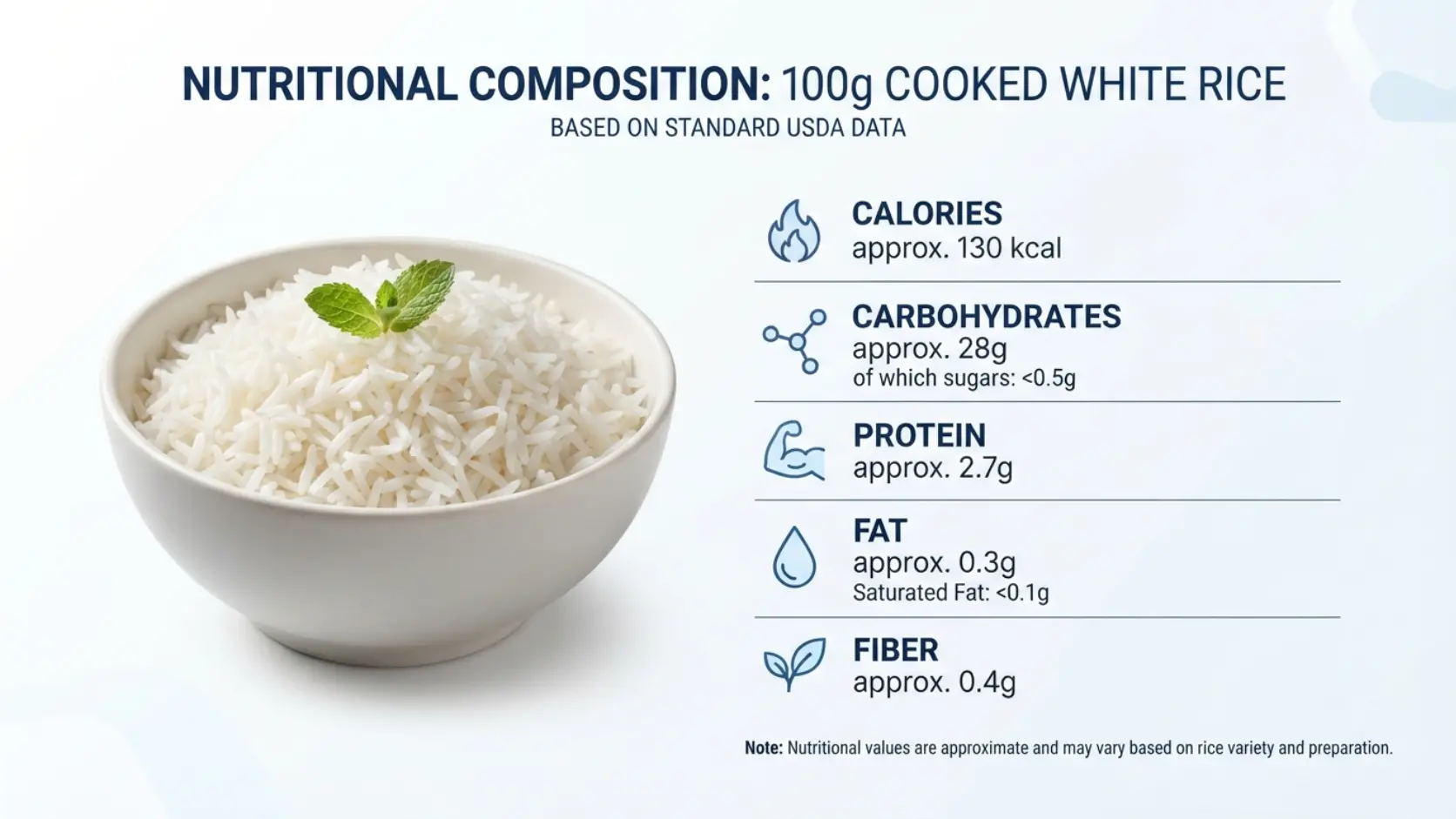
The rice nutritional value per 100g depends on whether the rice is measured cooked or uncooked and on the variety. As a general guide, 100g of cooked white rice provides about 130 calories, 28g carbohydrates, 2–3g protein and very little fat. Uncooked rice is considerably more calorie-dense because cooking adds water.
Important: Always check whether nutritional values refer to 100g cooked rice or 100g uncooked rice. This distinction can significantly change the numbers.
Rice Nutritional Value Per 100g: Cooked vs Uncooked
The first thing to establish is the form of the rice being measured.
Nutrient |
100g Cooked White Rice* |
100g Uncooked White Rice* |
|---|---|---|
Calories
|
~130 kcal
|
~350–370 kcal
|
Carbohydrates
|
~28 g
|
~77–80 g
|
Protein
|
~2–3 g
|
~6–8 g
|
Fat
|
<1 g
|
<1 g
|
Fibre
|
~0.3–0.5 g
|
~1–2 g
|
Water
|
~65–70 g
|
~10–15 g
|
*Approximate values. Actual nutrition varies by rice variety, brand, cooking method and water absorption.
Why is there such a large difference?
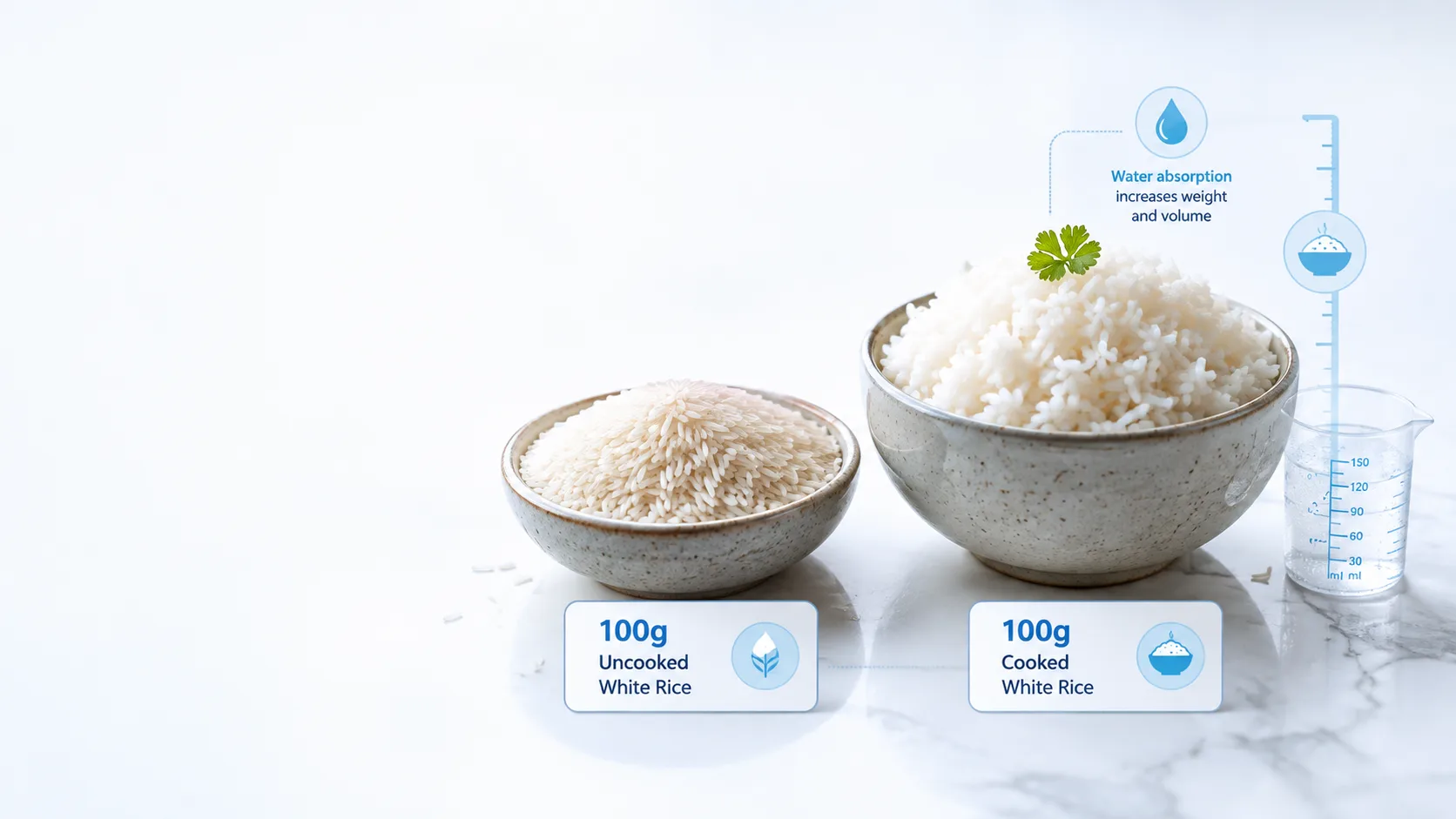
Cooking causes rice to absorb water.
The water adds weight without adding calories.
So, if 100g of dry rice becomes around 250–300g of cooked rice, the calories from the original rice are distributed across the larger cooked weight.
This is why 100g cooked rice cannot be compared directly with 100g uncooked rice.
What Nutrients Are Found in 100g of Cooked Rice?
Rice is primarily a source of carbohydrates, but it also provides smaller amounts of protein and other nutrients.
A typical 100g serving of cooked white rice provides:
Carbohydrates
Approximately 28g of carbohydrates.
Carbohydrates are the primary macronutrient in rice and provide energy.
Protein
Approximately 2–3g of protein.
Rice isn’t generally considered a high-protein food, which is why combining it with foods such as dal, beans, paneer, tofu, eggs, fish or other protein sources can create a more balanced meal.
Fat
Plain cooked rice contains very little fat.
However, the total fat can increase significantly when rice is prepared with:
- Ghee
- Butter
- Oil
- Coconut milk
- Cream
- Fried ingredients
Fibre
White rice contains relatively little fibre because the outer layers of the grain are removed during processing.
Brown rice generally contains more fibre.
Read Our Guide : Which rice is good for diabetes
Rice Calories Per 100g
For people tracking calorie intake, rice is often measured by weight.
Cooked white rice
100g cooked white rice ≈ 130 calories
Uncooked white rice
100g uncooked white rice ≈ 350–370 calories
These are useful general estimates rather than fixed values.
The exact number depends on:
- Rice variety
- Moisture content
- Cooking method
- Brand
- Degree of processing
If you’re tracking calories closely, use the nutrition information for the specific rice you’re consuming.
Read Our Guide : 100gm rice calories
Rice Carbohydrates Per 100g
Rice is predominantly carbohydrate-based.
Approximately:
100g cooked white rice → ~28g carbohydrates
This makes portion size particularly relevant for people who monitor carbohydrate intake.
However, the amount of carbohydrate in the meal isn’t determined by rice alone.
For example, a meal containing:
- 100g cooked rice
- Dal
- Vegetables
- Curd
has a different nutritional profile from a meal containing:
- 300g rice
- Potato curry
- Fried foods
- Sugary beverage
The complete meal matters.
Rice Protein Per 100g
Rice contains some protein, but it isn’t usually considered a major protein source.
Approximately 2–3g of protein per 100g cooked rice is a reasonable general estimate.
If you’re trying to increase protein intake, consider combining rice with:
- Dal
- Rajma
- Chana
- Paneer
- Tofu
- Eggs
- Fish
- Chicken
- Curd
This is especially relevant in traditional Indian meals, where rice is commonly paired with dal, legumes or dairy.
Rice is often paired with dal in Indian cuisine. You can also learn about calories in one bowl of dal and how portion size contributes to your overall meal.
White Rice vs Brown Rice Nutritional Value
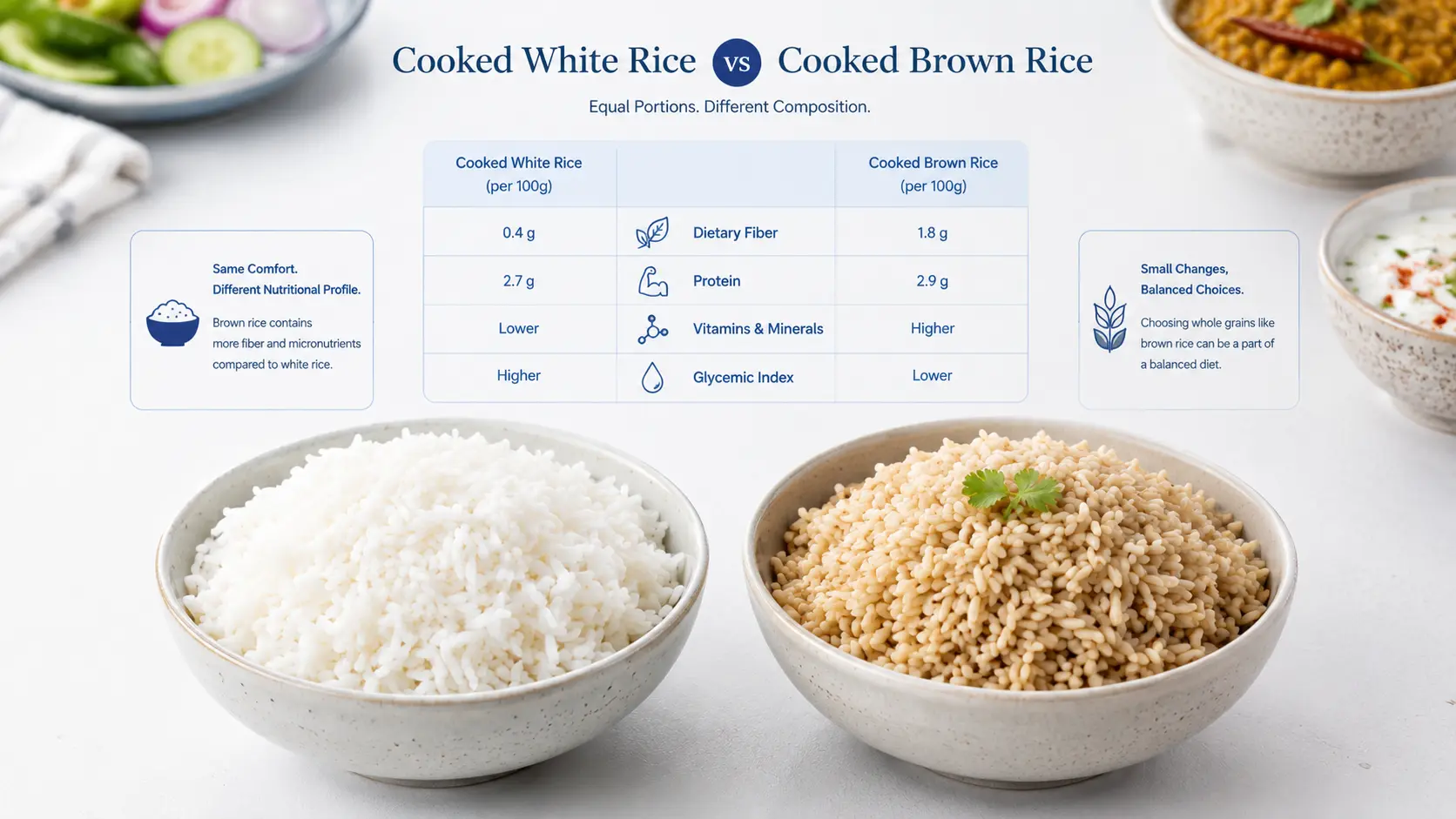
One of the most common questions is whether brown rice is nutritionally superior to white rice.
Both can fit into a healthy diet, but they aren’t nutritionally identical.
Nutrient / Feature |
White Rice |
Brown Rice |
|---|---|---|
Calories
|
Similar range
|
Similar range
|
Carbohydrates
|
High
|
High
|
Protein
|
Moderate/low
|
Slightly higher in some varieties
|
Fibre
|
Lower
|
Higher
|
Processing
|
More processed
|
Less processed
|
Texture
|
Soft
|
Chewier
|
Cooking time
|
Usually shorter
|
Usually longer
|
Brown rice retains more of the grain’s outer layers, which contributes to its higher fibre content.
This doesn’t mean white rice is inherently unhealthy.
The appropriate choice depends on the person’s dietary requirements, preferences and overall meal pattern.
Basmati Rice Nutritional Value Per 100g
Basmati rice is widely consumed in India and comes in both white and brown varieties.
The nutritional value varies depending on whether you’re measuring it cooked or uncooked.
Cooked basmati rice
A typical 100g serving can provide approximately:
- 120–140 calories
- Around 25–30g carbohydrates
- Approximately 2–3g protein
- Very little fat
Uncooked basmati rice
The calorie density is considerably higher because it has not absorbed cooking water.
Always check the nutrition label when using a packaged product.
Parboiled Rice Nutritional Value
Parboiled rice is partially cooked before milling.
This processing method can influence the nutritional composition and cooking characteristics of the rice.
Compared with standard white rice, parboiled rice may retain more nutrients from the grain during processing.
Its calorie content is still broadly comparable to other rice varieties when measured under similar conditions.
The more important considerations may be:
- Portion size
- Fibre
- Processing
- Overall meal composition
Rice and Weight Loss
Rice can be part of a weight-loss diet.
There is no requirement to completely eliminate rice simply because you’re trying to lose weight.
What matters is the relationship between your overall calorie intake and energy expenditure.
A practical approach is to control the rice portion while increasing the amount of:
- Vegetables
- Salad
- Protein-rich foods
- Fibre-rich foods
For example:
Instead of:
A very large serving of rice with a small amount of vegetables
Consider:
A moderate serving of rice with:
- Dal
- Paneer/tofu
- Plenty of vegetables
- Salad
This can make the meal more filling and nutritionally balanced.
Is Rice Good for Diabetes?
Rice can be included in many diabetes meal plans, but portion size and meal composition matter.
Because rice contains a significant amount of carbohydrate, the quantity consumed can affect blood glucose.
A person with diabetes may benefit from paying attention to:
- Rice portion size
- Type of rice
- Total carbohydrates in the meal
- Fibre intake
- Protein intake
- Individual blood glucose response
For example, pairing a moderate portion of rice with vegetables and protein may create a more balanced meal than consuming a large bowl of rice alone.
However, diabetes management should be individualized, particularly for people taking glucose-lowering medication.
Glycemic Index and Rice
The glycemic index (GI) describes how quickly a carbohydrate-containing food can raise blood glucose compared with a reference food.
Different types of rice can have different GI values.
GI can be affected by:
- Rice variety
- Processing
- Cooking time
- Degree of cooking
- Starch composition
- Meal composition
However, GI isn’t the only factor that matters.
The amount of carbohydrate consumed is also important.
This is why portion size remains relevant even when choosing a rice variety with a lower GI.
Does Cooking Change the Nutritional Value of Rice?
Yes.
Cooking changes the physical structure, moisture content and weight of rice.
The most obvious change is water absorption.
For example:
100g uncooked rice → significantly more than 100g cooked rice
The additional weight is primarily water.
Cooking can also influence starch structure and digestibility.
Different cooking methods can therefore produce slightly different nutritional and metabolic outcomes.
However, cooking rice in water doesn’t suddenly make its calories disappear.
Does Adding Oil or Ghee Change Rice Calories?
Absolutely.
Plain cooked rice contains very little fat.
But adding oil, ghee or butter increases the calorie content.
This is particularly important when comparing:
Plain rice
Rice + water
with:
Ghee rice
Rice + ghee
or:
Fried rice
Rice + oil + other ingredients
or:
Biryani
Rice + oil/ghee + meat or vegetables + additional ingredients
The calorie content of the finished dish can therefore be much higher than the nutritional value of plain cooked rice.
Rice Portion Size: How Much Should You Eat?
There isn’t a universal “correct” rice portion.
Your ideal portion depends on:
- Age
- Body size
- Physical activity
- Energy requirements
- Weight-management goals
- Diabetes status
- Other health conditions
- The rest of the meal
For someone tracking calories, using a kitchen scale can help establish consistent portions.
For everyday eating, you don’t necessarily need to weigh every meal.
A balanced plate approach can also be useful.
A Simple Indian Rice Meal
Consider this example:
Balanced meal
- Moderate portion of cooked rice
- Dal
- Mixed vegetables
- Salad
- Plain curd
This meal provides carbohydrates from rice, protein from dal and curd, and fibre and micronutrients from vegetables.
Compare that with:
Less balanced meal
- Large serving of rice
- Fried potato
- Fried papad
- Sugary drink
- Dessert
The rice isn’t necessarily the only issue.
The overall meal composition and portion size are what determine the nutritional quality of the meal.
Common Mistakes When Measuring Rice Nutrition
1. Confusing Cooked and Uncooked Rice
This is the biggest mistake.
Always check whether the nutritional information is based on dry or cooked weight.
2. Assuming All Rice Has the Same Nutrition
Different varieties can have different nutritional profiles.
Basmati, brown, red, black and parboiled rice aren’t identical.
3. Ignoring Added Ingredients
Rice cooked with oil, ghee, butter or coconut milk has a different nutritional profile from plain boiled rice.
4. Looking Only at Calories
Calories are important, but they’re not the only measure of nutritional quality.
Also consider:
- Fibre
- Protein
- Carbohydrates
- Micronutrients
- Portion size
- Overall meal composition
How to Calculate Rice Nutrition for Your Portion
If you’re using a food scale, the calculation is straightforward.
Suppose your cooked rice provides approximately:
130 calories per 100g
Then:
50g cooked rice
≈ 65 calories
100g cooked rice
≈ 130 calories
150g cooked rice
≈ 195 calories
200g cooked rice
≈ 260 calories
These are estimates and assume the same nutritional density throughout.
The same calculation can be applied to carbohydrates and other nutrients using the nutrition information from your specific rice.
Practical Tips for Tracking Rice
If you’re trying to lose weight:
- Measure your cooked portion consistently.
- Avoid automatically adding large amounts of oil or ghee.
- Include vegetables and protein.
- Track the complete meal rather than rice alone.
If you have diabetes:
- Pay attention to carbohydrate portions.
- Combine rice with protein and vegetables.
- Monitor your individual glucose response if advised by your healthcare professional.
- Discuss your meal plan with your doctor or dietitian if necessary.
If you’re an athlete:
Your carbohydrate requirements may be higher, particularly around training.
Therefore, a rice portion suitable for one person may not be suitable for another.
Frequently Asked Questions
The nutritional value varies depending on whether rice is cooked or uncooked. Approximately 100g of cooked white rice provides 130 calories, 28g carbohydrates, 2–3g protein and very little fat. Uncooked rice is considerably more calorie-dense.
Approximately 125–135 calories are found in 100g of cooked white rice. The exact amount varies according to rice variety, water absorption and cooking method.
100g of cooked white rice generally provides around 28g of carbohydrates. Uncooked rice contains substantially more carbohydrate per 100g because it contains much less water.
Brown rice generally contains more fibre because it retains more of the grain’s outer layers. However, both brown and white rice can be included in a balanced diet depending on individual nutritional needs.
Rice can be included in a weight-loss diet when portions are appropriate for your overall calorie requirements. Weight loss depends on total energy intake, activity and the overall quality of the diet.
Many people with diabetes can include rice in their diet, but portion size and total carbohydrate intake are important. Combining rice with protein and vegetables can help create a more balanced meal.
Cooking does not simply remove calories from rice. Rice absorbs water during cooking, increasing its weight and volume. As a result, calories are distributed across a larger cooked weight.
Conclusion
The rice nutritional value per 100g depends primarily on the type of rice and, most importantly, whether you’re measuring it cooked or uncooked. As a general reference, 100g of cooked white rice provides around 130 calories and 28g of carbohydrates, while uncooked rice is much more calorie-dense because it has not absorbed water.
Rice can be part of a healthy diet, including many weight-management and diabetes meal plans. The key is to consider portion size, rice variety, preparation method and what you eat alongside it.
For a more balanced Indian meal, pair a moderate rice portion with protein such as dal, paneer or curd and plenty of vegetables.