100g Rice Calories: Calories, Nutrition & Serving Guide
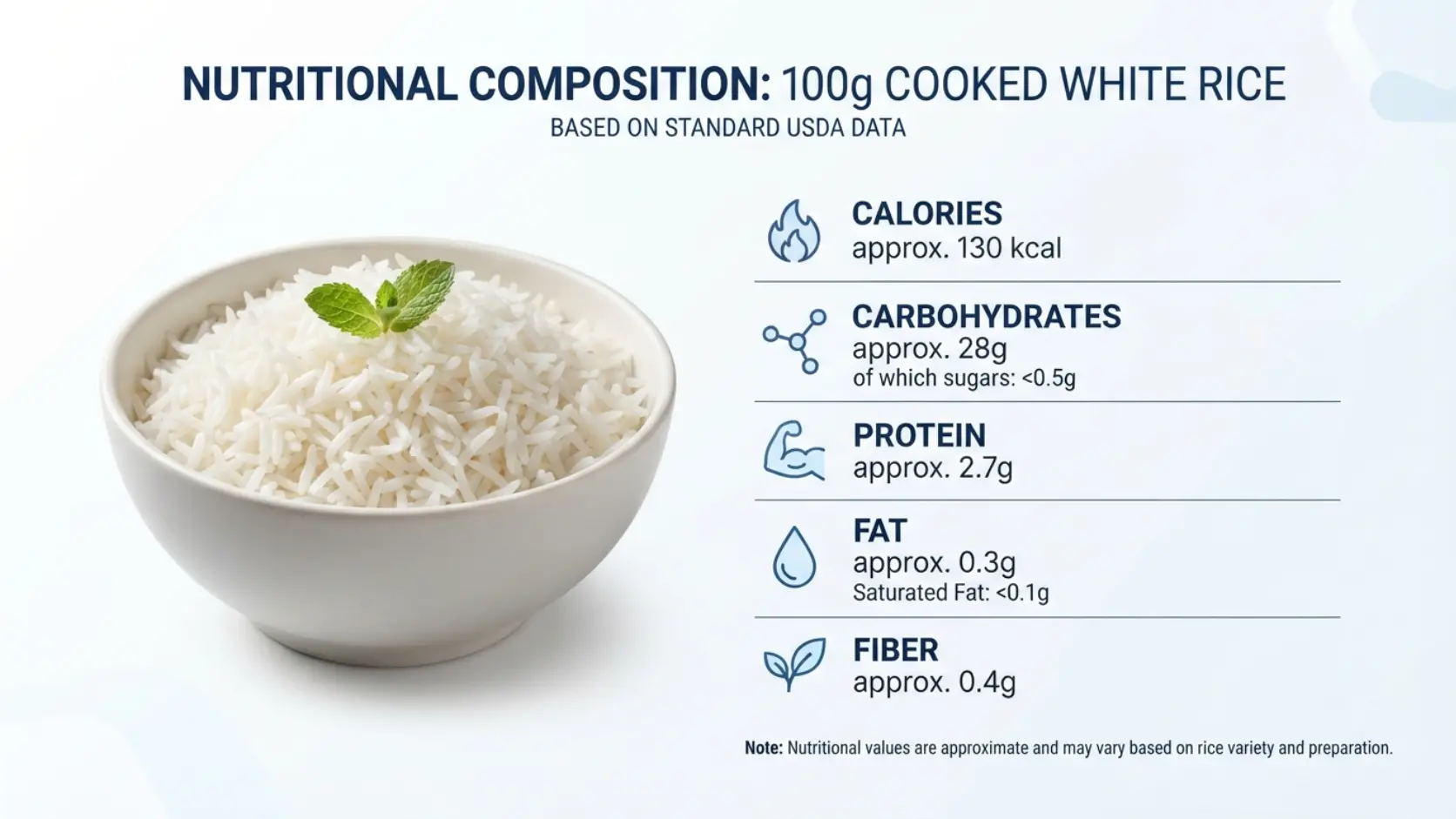
The calories in 100g of rice depend heavily on whether the rice is cooked or uncooked. As a general guide, 100g of cooked white rice contains around 130 calories, while 100g of uncooked white rice can contain roughly 350–370 calories. Water absorbed during cooking significantly changes the weight and calorie density of rice.
Important: When someone searches for 100gm rice calories, always check whether they mean 100g cooked rice or 100g raw rice. This is one of the most common sources of confusion when tracking calories.
100gm Rice Calories: Cooked vs Raw
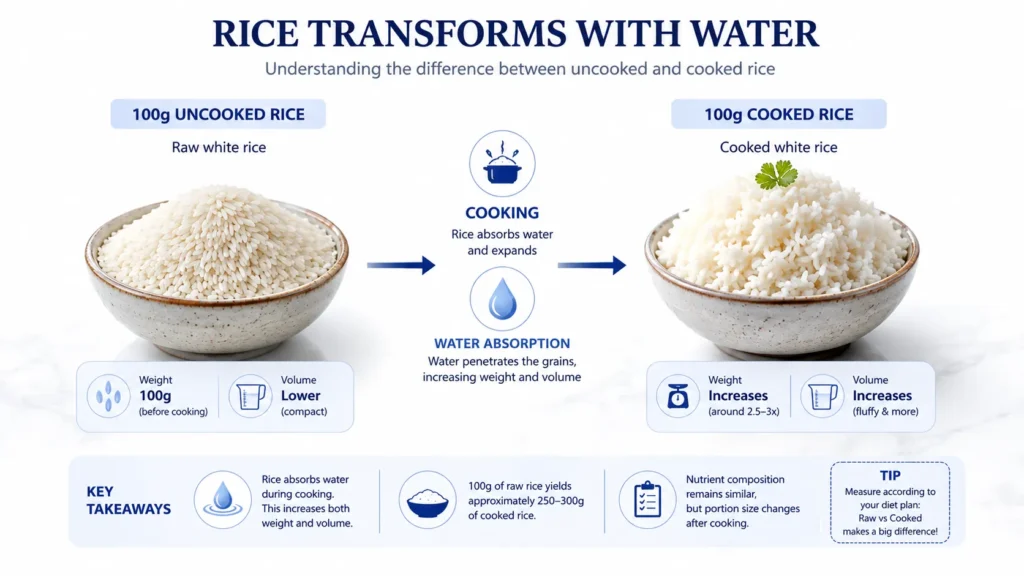
The biggest mistake people make when counting rice calories is comparing cooked and uncooked weights.
Rice measurement |
Approximate calories |
|---|---|
Full-fat paneer
|
~130 kcal
|
100g uncooked white rice
|
~350–370 kcal
|
100g cooked brown rice
|
~110–125 kcal
|
100g cooked basmati rice
|
~120–140 kcal
|
1 cup cooked white rice
|
~200–210 kcal
|
These figures are approximate because the final calorie content can vary according to rice variety, cooking method and water absorption.
For accurate calorie tracking, use the same measurement method consistently.
Why Does Cooked Rice Have Fewer Calories per 100g?
The answer is mainly water.
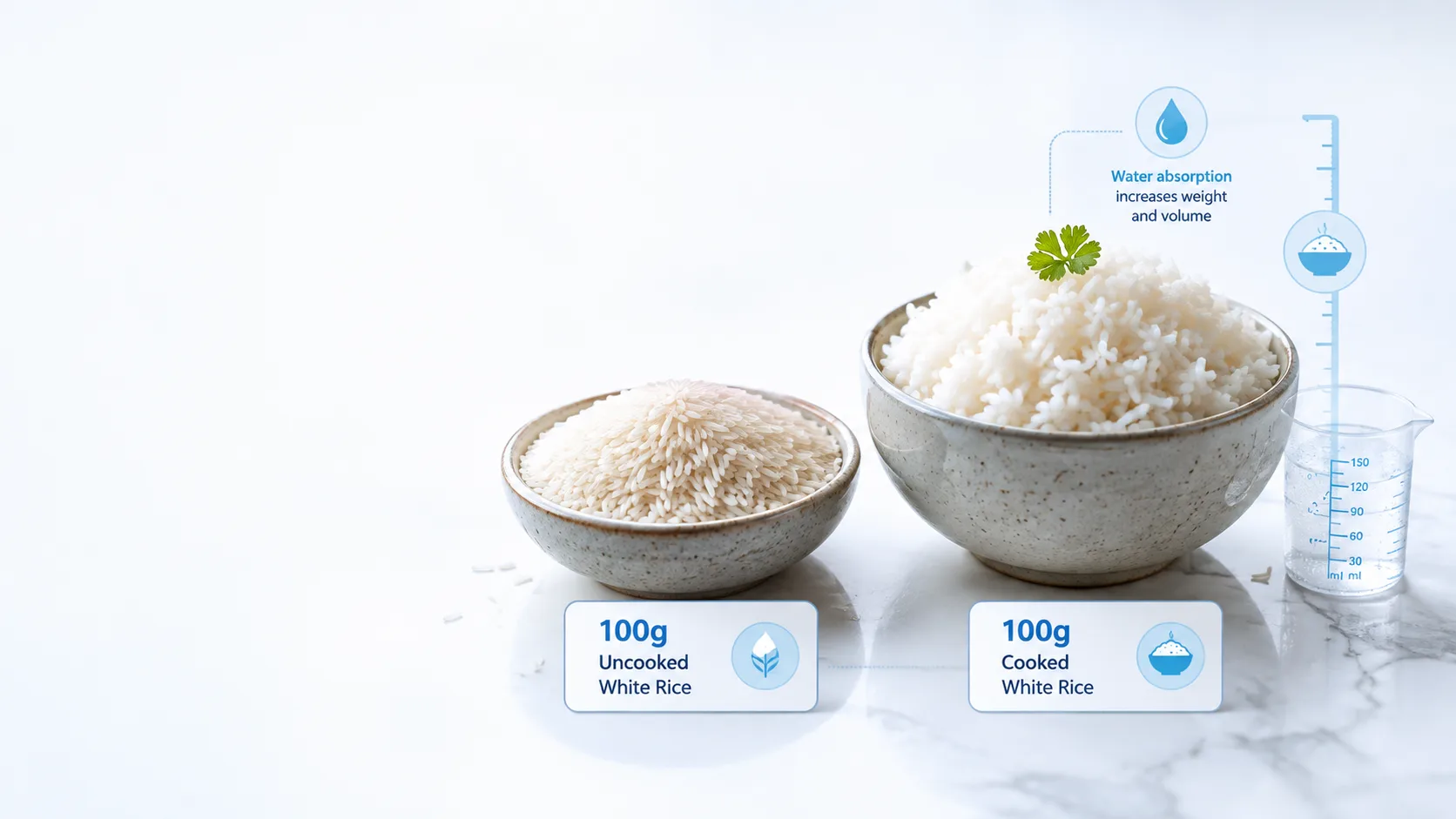
Raw rice contains relatively little water. During cooking, rice absorbs water and becomes heavier.
For example:
100g raw rice → considerably more than 100g cooked rice
The additional weight comes primarily from water, not additional calories.
The calories in the original rice haven’t disappeared. They are simply distributed across a larger cooked weight.
This is why comparing 100g raw rice with 100g cooked rice can give a misleading impression.
How Many Calories Are in 100g Cooked White Rice?
For most common cooked white rice varieties, 100g provides approximately 125–135 calories.
A typical serving also provides predominantly carbohydrates, with smaller amounts of protein and very little fat when the rice is cooked without added oil.
The exact value depends on:
- Rice variety
- Amount of water absorbed
- Cooking method
- Whether oil or ghee is added
- Final moisture content
If you’re tracking calories, weighing your cooked portion consistently can make your calculations easier.
How Many Calories Are in 100g Raw Rice?
Raw or uncooked rice is much more calorie-dense by weight.
100g uncooked rice generally provides around 350–370 calories, depending on the variety.
This is why using a food-tracking app without checking whether its entry refers to raw or cooked rice can lead to significant differences in your calorie calculations.
Example
Suppose you weigh:
100g uncooked rice
and then cook it.
The cooked rice may weigh considerably more because it has absorbed water.
If you subsequently weigh out only 100g of the cooked rice, you’re eating only part of the original 100g raw portion.
100gm Rice Calories by Rice Type
Different rice varieties have slightly different nutritional profiles.
Rice type |
Approximate calories per 100g cooked |
|---|---|
White rice
|
~125–135 kcal
|
Basmati rice
|
~120–140 kcal
|
Brown rice
|
~110–125 kcal
|
Parboiled rice
|
~120–130 kcal
|
Red rice
|
~110–130 kcal
|
Black rice
|
~120–145 kcal
|
These numbers should be treated as approximate ranges, not universal values.
The cooking method and water content can change the final weight considerably.
Is 100g Rice a Good Portion?
It depends on what you mean by 100g.
100g cooked rice
This is a relatively moderate portion and contains approximately 130 calories.
100g uncooked rice
This represents a much larger amount of food after cooking and contains roughly 350–370 calories before any additional ingredients are added.
Therefore, when someone says:
“I eat 100g rice.”
the first question should be:
100g before or after cooking?
100g Rice Calories for Weight Loss
Rice does not automatically prevent weight loss.
Weight loss depends primarily on maintaining an appropriate calorie deficit over time.
Rice can absolutely be included in a weight-loss diet.
The more important factors are:
- Portion size
- Total daily calorie intake
- Protein intake
- Vegetable and fibre intake
- Cooking method
- Physical activity
- Overall dietary pattern
A bowl of plain rice can fit into a calorie-controlled meal.
However, rice becomes much more calorie-dense when large amounts of:
- Ghee
- Butter
- Oil
- Fried ingredients
- Cream
- Rich gravies
are added.
How to Measure Rice for Weight Loss
If you’re tracking calories, consistency is more important than whether you choose cooked or uncooked measurement.
Option 1: Weigh rice before cooking
This can be useful when preparing a fixed quantity for several meals.
For example:
- Weigh the uncooked rice.
- Record the calories.
- Cook it.
- Divide the finished rice into portions.
Option 2: Weigh cooked rice
This can be easier when you’re serving yourself individual meals.
The key is to use a food database entry that specifically refers to cooked rice.
Does the Type of Rice Change Calories?
Yes, but usually not dramatically enough to make calorie count the only factor when choosing rice.
For example, brown rice and white rice have relatively similar calorie densities when compared under similar cooking conditions.
The bigger nutritional differences may relate to:
- Fibre
- Processing
- Micronutrients
- Glycemic response
- Satiety
- Portion size
Therefore, choosing rice should not be based exclusively on calories.
White Rice vs Brown Rice
Feature |
White Rice |
Brown Rice |
|---|---|---|
Processing
|
More processed
|
Less processed
|
Fibre
|
Lower
|
Higher
|
Calories
|
Similar range
|
Similar range
|
Texture
|
Softer
|
Chewier
|
Cooking time
|
Usually shorter
|
Usually longer
|
Nutritional profile
|
Provides carbohydrates
|
Provides carbohydrates + more fibre
|
Brown rice isn’t a “zero-calorie” alternative to white rice.
Its potential advantage is its higher fibre content and less refined structure.
Read Our Guide : Which rice is good for diabetes
100g Basmati Rice Calories
Basmati rice is particularly popular in Indian households.
The calorie content depends on whether you’re measuring it raw or cooked.
Cooked basmati rice
Approximately 120–140 calories per 100g is a reasonable general estimate.
Raw basmati rice
Approximately 350–370 calories per 100g may be expected, depending on the product.
Always check the package nutrition label when tracking a specific brand.
How Many Carbs Are in 100g Rice?
Cooked white rice generally contains around 28g of carbohydrate per 100g, although the exact amount varies with the type and water content.
This is important for people who track carbohydrate intake.
A larger portion naturally provides more carbohydrates.
For example, eating 200g cooked rice gives you approximately twice the amount of rice and roughly twice the carbohydrate contribution compared with 100g, assuming the same rice and preparation.
Does Cooling Rice Reduce Calories?
You may have heard that cooling cooked rice changes its starch and can affect how the body responds to it.
There is some scientific evidence that cooling and reheating certain starchy foods can increase resistant starch, but this does not mean that cooling rice magically removes most of its calories.
The overall calorie difference should not be treated as a reason to eat unlimited rice.
Portion size remains important.
Does Adding Oil Increase 100gm Rice Calories?
Yes.
Plain cooked rice has a relatively predictable calorie content.
But adding fats changes the equation.
Common additions include:
- Ghee
- Butter
- Coconut oil
- Vegetable oil
- Fried onions
Even a small amount of added fat can significantly increase the calories of a rice-based meal.
This is why restaurant rice dishes can contain substantially more calories than plain boiled or steamed rice.
Read Our Guide : Foods to avoid with diabetes
Rice Dishes Can Have Very Different Calories
Consider the difference between:
Plain steamed rice
Rice + water
versus:
Fried rice
Rice + oil + vegetables + sauces + other ingredients
versus:
Biryani
Rice + oil/ghee + meat or vegetables + fried onions + spices and other ingredients
All three contain rice.
But their total calorie content can be very different.
This is why searching only for 100gm rice calories isn’t enough when evaluating an entire meal.
Practical Example: Measuring Rice for Lunch
Imagine someone is trying to control their calorie intake.
They weigh:
150g cooked rice
If cooked rice provides approximately 130 calories per 100g, then 150g would provide roughly:
195 calories
They could pair this with:
- Dal
- Grilled paneer
- Vegetables
- Salad
- Unsweetened curd
The meal becomes more nutritionally balanced than eating a large portion of rice alone.
The exact calorie requirement, however, depends on the individual’s age, body size, activity level and health goals.
Read Our Guide : Calories in One Bowl of Dal
How to Include Rice in a Balanced Diet
1. Measure your portion
A kitchen weighing scale can help if you’re actively tracking calories.
2. Choose your measurement method
Decide whether you’re tracking rice before or after cooking.
3. Use the correct food database entry
Make sure the entry specifies cooked or uncooked.
4. Add protein
5. Add vegetables
Vegetables can increase the volume and fibre content of your meal.
6. Watch added fats
Oil, ghee and butter can substantially increase total calories.
Common Mistakes When Counting Rice Calories
Mistake 1: Confusing Raw and Cooked Weight
This is probably the biggest mistake.
100g raw rice and 100g cooked rice are not equivalent portions.
Mistake 2: Using the Wrong Database Entry
A calorie-tracking app may have separate entries for:
- White rice, cooked
- White rice, dry
- Basmati rice, cooked
- Basmati rice, dry
Choosing the wrong one can distort your calorie calculations.
Mistake 3: Forgetting Added Oil
Rice cooked with oil contains more calories than plain rice.
Mistake 4: Measuring the Entire Dish as Rice
If you’re eating biryani, pulao or fried rice, don’t automatically use the calorie value for plain cooked rice.
The other ingredients matter.
Is Rice Bad for Weight Loss?
No.
Rice can be included in a weight-loss diet.
The key is managing your overall calorie intake and portion sizes.
A person can lose weight while eating rice regularly if their overall diet supports an appropriate calorie deficit.
Likewise, someone can gain weight while eating “healthy” rice if portions are consistently excessive.
The focus should therefore be on the complete dietary pattern rather than eliminating individual foods unnecessarily.
Frequently Asked Questions
Approximately 125–135 calories are found in 100g of cooked white rice, while 100g of uncooked rice may contain around 350–370 calories. The exact value depends on the rice variety and moisture content.
100g of cooked white rice generally contains around 130 calories. The exact number can vary depending on the variety and how much water the rice absorbs during cooking.
100g of uncooked rice generally contains approximately 350–370 calories, depending on the rice variety and product.
100g of cooked rice can fit comfortably into many calorie-controlled meals. Whether it is appropriate for weight loss depends on your overall calorie intake, meal composition and individual energy requirements.
100g of cooked white rice generally contains around 28g of carbohydrates, although the exact amount varies according to rice type and cooking method.
Brown and white rice have broadly similar calorie ranges when measured under comparable cooking conditions. Brown rice’s main nutritional advantage is its higher fibre content rather than a dramatically lower calorie count.
Rice can be included in many diabetes meal plans, but the appropriate portion varies by individual. A moderate portion combined with protein, vegetables and other nutrient-dense foods may be more suitable than a large serving of rice alone.
Conclusion
When searching for 100gm rice calories, the most important thing to remember is whether you’re measuring cooked or uncooked rice. Around 130 calories per 100g of cooked white rice is a useful general estimate, while 100g of uncooked rice can contain roughly 350–370 calories.
Rice doesn’t have to be eliminated for weight loss or diabetes management. What matters more is portion size, total calorie intake, carbohydrate intake, preparation method and what you eat alongside it.
For a balanced Indian meal, consider combining a moderate rice portion with protein such as dal or paneer, plenty of vegetables and other nutrient-dense foods.
If you’re tracking calories, use a kitchen scale and make sure your food-tracking entry clearly states whether the rice is cooked or uncooked. This simple distinction can make your calorie tracking much more accurate.